
Seized by Art: Grasping Untimely Art and Politics in the 1960s with Yoshio Nakajima
Open lecture by professor William Marotti, University of California.
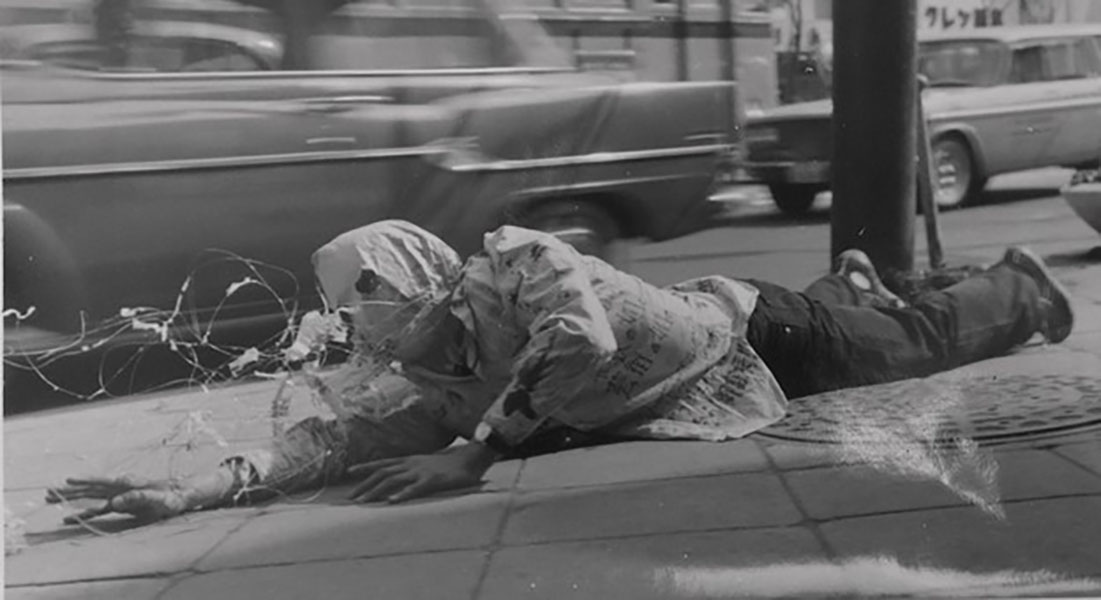
Join us to hear Professor William Marotti talk about the pivotal yet overlooked career of the “Japanese artist from Sweden,” Yoshio Nakajima, and the relations of art, politics, and violence in the 1960s and the very possibilities of art.
The Japanese artist from Sweden, Yoshio Nakajima, has been remarkably pivotal for major movements in art and politics in the 1960s from Japan to Europe—and remarkably overlooked by nation-focused art histories. Nakajima’s storied career has traversed an astounding range of locations, scenes, and movements as well as media and performance modes. The paradox of Nakajima’s work is that, despite its apparent exemplification of art’s potential to move and to transform, it has largely fallen out of accounts in which its impact might have justifiably featured.
Nakajima’s street performance work predates similar and better-known explorations by avant-gardists in Tokyo and beyond; his chanting, free-form, often collaborative public performances across Europe played a role in jump-starting spaces of possibility, from Tokyo to Ubbeboda, from Spui square and the Dutch Provos to Antwerp and Sweden.
Nakajima’s work, timely in its untimeliness, allowed others to see and experience the world differently. Following its elusive actuality, in turn, reveals the potential of such art and politics as an ever-present possibility. With help from the observations of contemporaneous critic Yoshida Yoshie, I consider the relations of art, politics, and violence in the 1960s and the very possibilities of art.
Bio
William Marotti is Professor of History and Chair of the East Asian Studies MA IDP Program at UCLA. He teaches modern Japanese history with an emphasis on everyday life and cultural-historical issues. Marotti's Money, Trains and Guillotines: Art and Revolution in 1960s Japan (Duke University Press, 2013) addresses politics in Japan in the 1960s through a focus upon avant-garde artistic production and performance.
His current book project, “The Art of Revolution: Politics and Aesthetic Dissent in Japan’s 1968,” analyzes cultural politics and oppositional practices in Japan with particular emphasis on 1968 as a global event.
Map of South Campus
View directions.
View on map of the Faculty of Humanities - South Campus.
View map of South Campus (pdf).