
East European Studies
The East Europe research group carries out interdisciplinary language-based studies in post-Soviet and post-communist regional contexts, with a focus on history, culture, societies and politics in Russia, Ukraine, the Western Balkans and Poland.
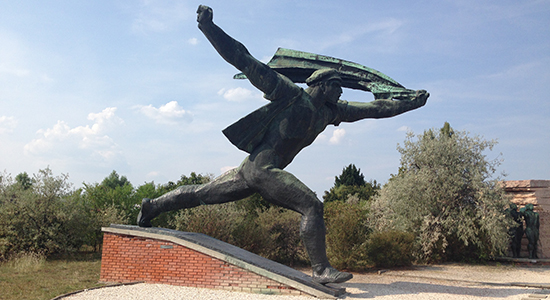
The research in the East European section is driven by the importance of understanding cultures, societies, political development and global relations in this region in the context of its rich, multilayered and often internally contradictory historical legacies. The area, which has often been defined as a borderland between the “West” and the “East”, taps into the cultural heritages of Byzantium, the world of Islam, Western Europe, and the nomadic cultures of Central Asia. In the past, the region was dominated by the powerful continental empires of the Ottomans, Habsburgs and Romanovs. In the 20th century, it emerged as the brutal testing ground for the ideas of communism and as the geopolitical competitor of Western capitalist society and liberal democracies. The inquiry into Eastern Europe as a unique historical phenomenon and ongoing battlefield in Europe requires multidimensional and interdisciplinary studies.
The research group on East Europe focuses on such fields as identity and memory politics, uses of history, propaganda, ideology and conceptual history, protest and political activism, minorities, migration, literatures and censorship, languages and translation, religion, cultural heritage, media and films.
The group’s scholarly expertise is especially strong in covering such topics as contemporary history and politics in South-Eastern Europe, Polish history, culture and arts, Russian and post-Soviet literature, post-Soviet Russian politics, society, ideology, culture as well as migration and minorities in today’s Central Asia and Ukraine. The group has made an important contribution to the general media coverage of the most topical events and cultural production in the region, and informed the national audience about the region’s main cultural and political features. Members of this group have published extensively in national and international academic and non-academic journals and publishing houses.
- Postwar memory generations - Contested memory, historical narratives and history education in Bosnia-Herzegovina and Serbia
- Networking the War: An Ethnographic-Analytical Study of Minority Perspectives, Mobility, and Recovery in War-Affected Ukraine Independent Research Fund Denmark, PI: Vera Skvirskaja, project period: 2025-2028
Continentalism and Geopolitics: The Idea of ‘Big-Space’ Political Formations in Comparative Historical Perspective
Funding: Vetenskapsrådet
Project period: 2018 - 2020
Contact: Mikhail Suslov
Mnemonic Migration
Bevillingsgiver: Independent Research Fund Denmark
Project period: September 2019 - August 2022
Contact: Tea Sindbæk Andersen
The Afterlives of Urban Muslim Asia. Alternative Imaginaries of Society and Polity
Bevillingsgiver: The Arts and Humanities Research Council (AHRC), UK
Project period: 2022 – 2024
Contact: Co-PI Vera Skvirskaja
Researchers and lecturers
| Name | Title | Job responsibilities | Phone | |
|---|---|---|---|---|
| Andersen, Tea Sindbæk | Associate Professor | Balkan Studies | +4521671923 | |
| Bonin, Rachel Hanna | PhD Fellow | |||
| Dedovic, Ismar | Postdoc | |||
| Eskildsen, Mads Büchert | Teaching Associate Professor | Russian Studies | +4551303067 | |
| Kirk, Marianne Madsen | PhD Fellow | Balkan Studies | ||
| Krakus, Anna Helena Alexandra | Associate Professor | Polish Studies | +4535332258 | |
| Krgovic, Marija | Enrolled PhD Student | +4535330197 | ||
| Lorentzen, Elena | Associate Professor | Russian Studies | +4551303062 | |
| Madsen, Martin Schou | Teaching Associate Professor | Balkan Studies | +4551303058 | |
| Pluwak, Anita | Teaching Associate Professor | Polish Studies | +4551300810 | |
| Roesen, Tine | Associate Professor | Russian Studies | +4551302529 | |
| Skvirskaja, Vera | Associate Professor | |||
| Suslov, Mikhail | Associate Professor | Russian Studies |